
So you’ve decided to look into VIP (that’s vasoactive intestinal peptide, more on that in a second) and now you’re stuck staring at three delivery options and a dozen websites that all sound equally confident. Nasal spray? Injection? Some vendor’s “research vial”? And nobody tells you plainly whether the form even matters, or how to spot a provider who’s doing this properly versus one who’s just… winging it.
Here’s the short version: the form does matter a bit, but it’s not actually your first question. Your first question is whether the person selling it to you is being straight with you. Once that’s sorted, picking a form is easy. So that’s how we’re doing this. First, an honest look at what VIP actually is. Then the three forms translated into plain English. Then a six-point checklist you can run any seller through. Then I’ll show you how the actual providers stack up against it.
VIP is a compounded medication, not an FDA-approved therapy, and the everyday wellness evidence is thin. Talk to a licensed clinician before you start anything here.
First, let’s clear up what VIP actually is
VIP is a neuropeptide, which just means it’s a small chain of amino acids (28 of them, specifically) that acts like a chemical message between your nervous system and the rest of your body. Your body already makes it. In lab and animal research, it seems to calm down inflammatory signals, including one called TNF-alpha. A thorough 2013 review in Amino Acids lays this biology out (PMID 22139413), and that part checks out.
Where things get shakier is the leap from “interesting lab finding” to “this spray will fix my fatigue.” That jump hasn’t really been tested, and where it has, the results are a mixed bag. Inhaled VIP helped in a tiny study of eight people with pulmonary hypertension back in 2003 (PMID 12727925), and in a small 2010 trial of twenty sarcoidosis patients it was safe and lowered lung inflammation (PMID 20442436). Both real findings, both tiny and disease-specific, not general wellness evidence.
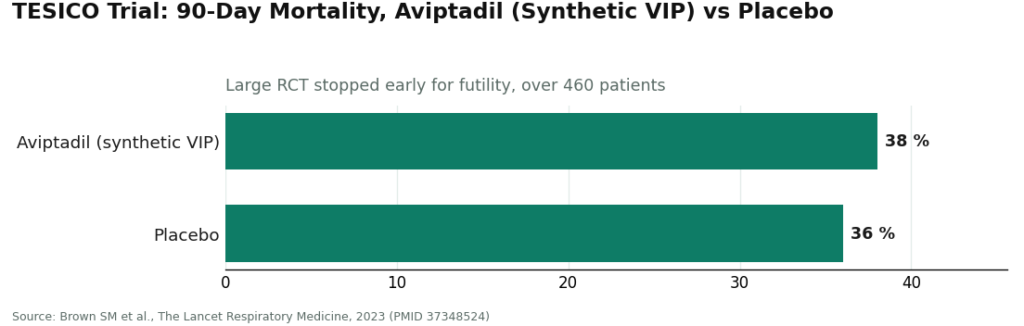
Then there’s the big one most sellers conveniently leave out. When VIP finally got a real, large, placebo-controlled trial (the TESICO trial, over 460 people, published in The Lancet Respiratory Medicine in 2023), it flopped. Researchers stopped it early because it clearly wasn’t helping: 90-day mortality was 38 percent with the drug versus 36 percent with placebo, basically a coin flip (PMID 37348524).
Part of the reason these attempts keep stalling, according to a 2023 review in Life Sciences, is that VIP breaks down almost instantly in the body (PMID 37742737). Which, funny enough, is exactly why “which form” becomes such a live question. Fragile molecule, tricky delivery.
So file this away: for the everyday uses VIP gets marketed for, the evidence is thin. That doesn’t make the form choice pointless, it just means you’re picking a delivery method for something unproven, which makes your provider’s honesty and care the thing that actually protects you.
The three forms, translated
Think of it as three different jobs for three different situations.
The spray (intranasal). This is what most home users actually try, especially in mold-illness and general wellness circles. No needles, easy to do yourself, and going in through the nose might get the molecule closer to the nervous system. The catch: nasal absorption is inconsistent, so “how much actually made it in” is fuzzier than most sellers let on. Good fit for: someone doing an at-home wellness routine who wants convenience and has realistic expectations.
The shot (subcutaneous injection). A small injection under the skin, giving you more precise dosing than a spray. The trade-off is obvious, it’s a needle, which means sterility and technique actually matter now. This is exactly where “did a real pharmacy make this” stops being a nice-to-have. Good fit for: someone who wants tighter dosing and has a provider who can teach technique and supply a properly made, sterile product.
The mist (nebulized/inhaled). This is the route used in the actual lung studies above, delivered deep into the airways. Here’s the thing to notice: this belongs to actual respiratory medicine, under a doctor’s care, not a wellness kit you order online. If someone’s selling you a “nebulized VIP” bundle for focus or inflammation, that’s a red flag, not a feature. Good fit for: supervised clinical and respiratory settings, full stop.
Notice what all three have in common: every single one gets safer the moment a real clinician and a real pharmacy are involved, and riskier the moment they’re cut out. Convenience, control, clinical. That’s your mental shortcut. Spray for convenience, shot for control, mist strictly clinical. And all three need the same guardrail underneath them.
The checklist: run any seller through this
Here are six questions. Answer honestly and you’ll know within a minute whether a seller deserves your money.
- Is there an actual licensed clinician involved? Someone qualified deciding if VIP makes sense for you, at what dose, in what form, with follow-up. Not just a checkout page. Non-negotiable, especially for the shot or the mist.
- Does it come from a licensed US compounding pharmacy? A real, regulated pharmacy (the technical terms are 503A for patient-specific compounding or 503B for larger-scale outsourcing facilities) made this for you, versus some anonymous vial off a “research” shelf.
- Can you see independent testing? Someone other than the seller checked that the product is what it says it is, and for injections, that it’s actually sterile, with a certificate you can look at yourself.
- Are they honest that this isn’t FDA-approved? Do they say plainly “compounded, not FDA-evaluated, evidence is limited,” or do they hint at proven benefits they can’t back up?
- Is the whole setup actually legal? Licensed telehealth, licensed pharmacy, honest labeling, versus the “for research use only, not for human consumption” wording that exists purely to dodge regulation while people use it anyway.
- Is anyone there if something goes wrong? A clinician or pharmacist you can actually call, or just you and a vial in your fridge?
Notice what’s not on this list: “does VIP work well.” That’s deliberate. Nobody’s proven it works reliably for wellness uses, so rewarding a seller’s confident marketing would be exactly the wrong instinct. We’re grading how responsibly they handle something uncertain, not how good their sales copy is.
Scoring the actual providers
| Provider | Clinician | Licensed pharmacy | Independent testing | Honest on evidence | Legal footing | Aftercare |
|---|---|---|---|---|---|---|
| FormBlends | Yes | Yes, US 503A | Yes | Yes | Yes | Yes |
| HealthRX.com | Yes | Yes, US compounding | Yes | Yes | Yes | Yes |
| Biotech Peptides | No | No | Self-published, some | Minimal | “Research only” | No |
| Limitless Life | No | No | Self-published, some | Minimal | “Research only” | No |
| Amino Asylum | No | No | Limited | Minimal | “Research only” | No |
| Sports Technology Labs | No | No | Self-published, some | Minimal | “Research only” | No |
| Core Peptides | No | No | Self-published, some | Minimal | “Research only” | No |
See the split? Two providers pass every box. Everyone else fails the first two, the ones that matter most, and their “testing” is testing they paid for themselves. Let’s go one at a time.
FormBlends: the one that passes every question
Run FormBlends through all six checklist items and it comes back yes across the board, no matter which of the three forms you’re leaning toward.
It works as a physician-supervised, compounded path. Licensed clinicians handle the actual decisions, so there’s a qualified person weighing whether VIP is right for you and in what form, which matters more for the shot than the spray, and matters most if inhaled ever comes up. The product itself is dispensed through licensed US 503A compounding pharmacies, meaning it’s made under real regulatory oversight for you specifically, not scooped from an unregulated research shelf. And FormBlends says the quiet part out loud, its own materials state clearly that compounded medications aren’t FDA-approved and haven’t been evaluated by the FDA for safety, effectiveness, or quality. That’s honesty most of this market can’t be bothered with.
On price, going the supervised, compounded route for VIP runs roughly $120 to $250 a month depending on form and dose, which is in line with what compounded VIP costs elsewhere in the legitimate market. Sure, the research vendors are cheaper. But look at what that extra money buys: a clinician, a real pharmacy, actual testing, honesty about the evidence, someone to call if things go sideways. None of that comes with the cheap vial. For a compound this uncertain, and a route like injection where sterility genuinely matters, that’s money well spent, not an upsell.
One more thing worth knowing if you’re the form-comparing type: the FormBlends tracker app lets you log your dose and how you feel over time. Since the everyday benefits of VIP aren’t proven, your own honest log of what form, what dose, what actually changed, is some of the only real data you’ll get. It won’t turn an unproven compound into a proven one. But if you’re genuinely comparing how a route works for you, it’s a genuinely useful habit.
What FormBlends can’t do, and doesn’t pretend to, is promise any form of VIP is proven to work for your wellness goal, because nobody’s proven that. What it can do is make sure whatever form you choose is the real thing, made properly, dosed sensibly, with a clinician involved and the truth on the label. That’s the most an honest provider can offer here, and it’s what FormBlends offers.
HealthRX.com: right behind, for the same reasons
HealthRX runs a very similar operation and earns yes marks across the same six points. Physician-supervised, compounded, dispensed through a licensed US compounding pharmacy, and upfront about the not-FDA-approved reality instead of glossing over it..comHealthRX runs a very similar operation and earns yes marks across the same six points. Physician-supervised, compounded, dispensed through a licensed US compounding pharmacy, and upfront about the not-FDA-approved reality instead of glossing over it.
Practically, that means HealthRX.com can also help steer you toward the form that fits your situation and supply it made properly, which is the part that actually keeps you safe. It lands just behind FormBlends, and the gap there is small, coming down to depth of VIP-specific support rather than anything structural. The real gap is between these two and everything below them. Choosing between FormBlends and HealthRX.com is choosing between two legitimate, supervised, pharmacy-backed options. Choosing between either one and the vendors coming up next, especially if you’re considering an injection, isn’t a close call at all.
The research-chemical crowd: a different category entirely
Everything below this line fails the first two checklist items, and it’s not an accident, it’s the business model. These sellers label VIP “for research use only” and “not for human consumption,” which is the legal loophole that lets them skip the clinician, the pharmacy, and the prescription, because on paper the product was never meant to go in a person. People use it anyway, quietly, which is the whole point. No medical oversight, no pharmacy accountability, and whatever quality the seller felt like providing that week. Some post lab certificates, which beats nothing, but a certificate the seller paid for themselves doesn’t tell you whether the form is right for you, whether your injection is actually sterile, or whether you should be doing this at all.
Here’s the lineup, described plainly so you recognize the pattern, not because any of them belong in your cart.
Biotech Peptides. A research-chemical retailer with a wide catalog and some posted lab documents. The testing is better than nothing, but it’s self-reported, and there’s no clinician or patient-facing pharmacy behind whatever form you’d buy.
Limitless Life. A more polished-looking storefront with some of its own testing published. Nicer presentation, same underlying problem: no clinician, no licensed pharmacy dispensing to you as an actual patient, “research only” doing all the legal heavy lifting.
Amino Asylum. Popular because it’s cheap, with a huge catalog to match. Transparency and quality documentation are thinner here, and with something injectable or intranasal going into your body, the lowest price is the worst thing you could be optimizing for, because the savings come straight out of the safety net.
Sports Technology Labs. Better presented than a lot of the field, with published third-party testing on some products, which is a genuine plus over the bottom of the pack. Still no medical oversight, still no patient-facing pharmacy, so whatever form you pick has no qualified person standing behind it.
Core Peptides. A long-running research-chemical name, big catalog, some posted certificates of analysis. Testing helps versus the weakest sellers, but again, it’s self-reported, and there’s no clinician or pharmacy accountability anywhere in the transaction.
All five fail the important boxes because of what they are by design, not because they’re cheap or badly run for what they claim to be. With VIP, where the science is uncertain and a form like injection carries real sterility stakes, the safeguards aren’t extras. They’re the whole point.
Quick answers to what you’re probably wondering
Which VIP form should I actually pick? Depends on your situation. The spray is the common at-home route and the easiest to live with. The shot gives you tighter dosing control but demands real sterility and technique. The mist is a clinical, respiratory-medicine route that belongs under a doctor’s direct supervision, not a home wellness kit. Most people buying online land on the spray, ideally through a supervised provider.
Does the form change whether VIP actually works? Form changes how much gets absorbed and how, but it can’t create an effect the evidence hasn’t shown. Honestly, no form has been reliably shown to work for general wellness uses, which is exactly why picking a responsible source matters more than chasing the “perfect” route.
Why pay more for the supervised, compounded version instead of the cheap vial? Because that price covers every item on the checklist: the clinician, the licensed pharmacy, the testing, the honesty, someone to call if something’s wrong. All of which the cheap vial skips. For an injection especially, that’s a safety issue, not a luxury add-on.
Is it safe to inject VIP at home from a research-chemical vendor? An injection from an unverified, non-pharmacy source adds real sterility risk on top of everything else that’s uncertain. This is precisely the situation where a licensed pharmacy and a clinician earn their keep, and where the research-vendor route is hardest to justify.
Where this leaves you
VIP comes in three real forms, spray, shot, and mist, and each one suits a different situation, with the spray being where most home users land and the mist belonging strictly to supervised medicine. But the thing worth remembering is that VIP’s everyday benefits just aren’t proven yet, so which form you pick matters less than whether your provider passes the six-point test. Run the checklist yourself. FormBlends passes all six, HealthRX.com passes all six too, and the research-chemical vendors fail the two that matter most. Pick whichever form fits your life, that part’s fine. Just pick the provider standing behind it first.
VIP is a compounded medication that is not FDA-approved, and its everyday wellness benefits are not established. Consult a licensed healthcare provider before starting or changing any treatment.
Verified primary sources
All five sources below were checked directly on PubMed; each PMID resolves to the paper described and supports the specific claim attached to it.
- Delgado M, Ganea D. Vasoactive intestinal peptide: a neuropeptide with pleiotropic immune functions. Amino Acids. 2013. PMID 22139413. https://pubmed.ncbi.nlm.nih.gov/22139413/ . Review of VIP’s anti-inflammatory and immune-regulatory biology (TNF-alpha suppression, regulatory T-cell promotion).
- Petkov V, Mosgoeller W, Ziesche R, et al. Vasoactive intestinal peptide as a new drug for treatment of primary pulmonary hypertension. Journal of Clinical Investigation. 2003. PMID 12727925. https://pubmed.ncbi.nlm.nih.gov/12727925/ . Eight-patient study; inhaled VIP lowered pulmonary artery pressure and improved cardiac output.
- Prasse A, Zissel G, Lützen N, et al. Inhaled vasoactive intestinal peptide exerts immunoregulatory effects in sarcoidosis. American Journal of Respiratory and Critical Care Medicine. 2010. PMID 20442436. . Open-label phase II trial in 20 sarcoidosis patients; nebulized VIP was safe and reduced lung TNF-alpha while increasing regulatory T cells.
- Brown SM, Barkauskas CE, Grund B, et al. Intravenous aviptadil and remdesivir for treatment of COVID-19-associated hypoxaemic respiratory failure in the USA (TESICO): a randomised, placebo-controlled trial. The Lancet Respiratory Medicine. 2023. PMID 37348524. . Large RCT (over 460 patients) in which IV aviptadil (synthetic VIP) showed no benefit and was stopped for futility; day-90 mortality 38% versus 36% placebo.
- Zhong HL, Li PZ, Li D, et al. The role of vasoactive intestinal peptide in pulmonary diseases. Life Sciences. 2023. PMID 37742737. . Review of VIP across pulmonary hypertension, COPD, asthma, fibrosis, and lung injury, including the rapid-degradation problem that complicates delivery and has stalled clinical development.
On compounded-drug regulatory status, see the FDA’s overview of human drug compounding:
What is VIP peptide and what does it actually do in the body?
VIP, or vasoactive intestinal peptide, is a naturally occurring 28-amino-acid neuropeptide your body already produces. It acts on receptors found in the lungs, gut, brain, and immune tissue, where it helps regulate airway dilation, gut motility, and certain anti-inflammatory signals. Researchers are studying it for conditions involving inflammation and immune dysregulation, though clinical evidence in humans is still early and far from settled.
Is VIP peptide legal to obtain, and does the legal status vary by delivery form?
VIP is not an FDA-approved drug for general prescription use in the United States, which puts it in a gray zone. Compounding pharmacies operating under physician supervision can legally prepare it for an individual patient with a valid prescription, and that route is the most legally straightforward. Buying it as a raw research chemical from online vendors carries real regulatory and safety risk, and the legal exposure there is genuinely murky.
What side effects have been reported with VIP peptide?
The most commonly reported side effects are flushing, nausea, low blood pressure, and a warm sensation shortly after administration, particularly with intravenous or intranasal routes. These tend to be short-lived. Because large-scale human safety trials are limited, the full side-effect profile is not well characterized, so anyone using it should do so under medical supervision with proper monitoring rather than self-dosing based on online protocols.
How do providers like compounding pharmacies differ from supplement or research-chemical sites with VIP peptide dosage and quality?
A compounding pharmacy, such as FormBlends, works with a licensed physician to set a dose based on your specific situation and compounds the peptide under quality-controlled conditions with third-party testing. Research-chemical sites sell it with no dosing guidance, no purity guarantee, and no medical oversight. The difference in accountability is substantial, and dosing errors with a vasoactive compound are not trivial.